


Tape Lifts, Swabs, and Bulk Samples: How to Choose the Right Surface Sampling Method
- Posted on: January 25, 2026
When collecting surface samples for mold testing, not all sampling methods are created equal. Each method has specific strengths and limitations, and you may choose differently depending on your priorities and the conditions on site.
The most common options for surface sampling are:
- Tape lifts
- Bulk sampling
- Dry swabs
- Wet swabs
Below is a practical guide to when Moldlab recommends each method-and when we recommend avoiding one altogether. The suggestions provided below correlate with our lab procedures and may not be applicable to other laboratories.
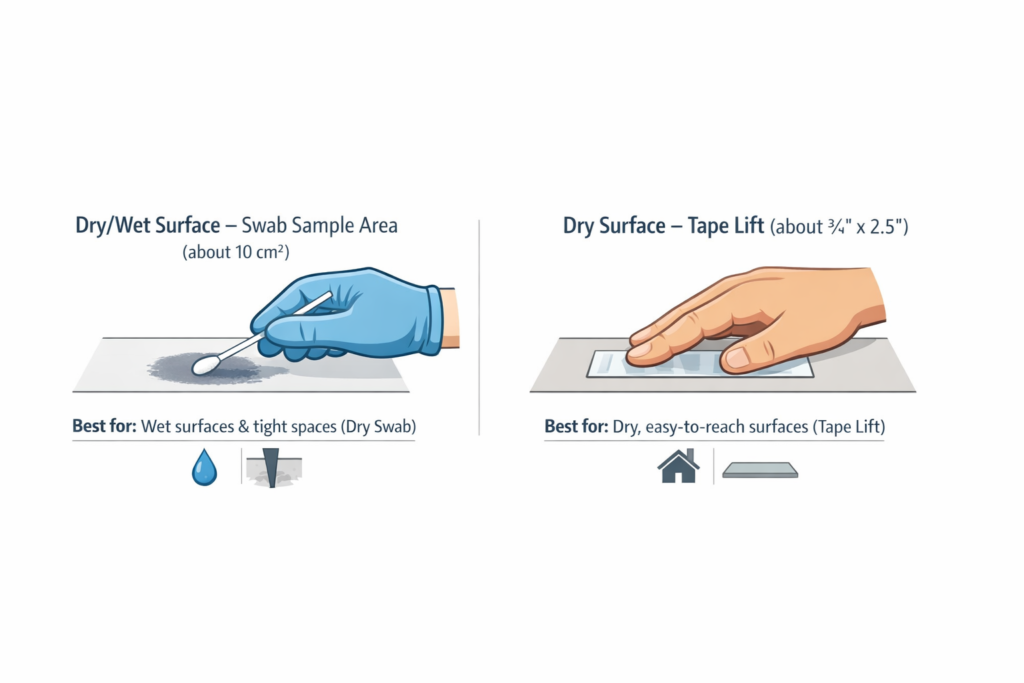
Quick Summary: Which Method Should You Use?
- Tape Lifts – Best for dry surfaces that are easy to reach.
- Dry Swabs – Best for wet surfaces and tight or hard-to-reach areas.
- Bulk Sampling – Best when you’re unsure which exact spot to test and destructive sampling is acceptable.
- Wet Swabs – Not recommended.
Tape Lift Sampling
Tape lift sampling involves gently pressing a piece of clear adhesive tape against a surface to collect visible or suspected mold growth.
When Moldlab preps a Tape Lift sample, we place the entire tape lift on a microscope slide when possible. If that isn’t possible, we cut a smaller section out to place on a microscope slide.
Advantages:
- Excellent for quantitative analysis: Tape lifts preserve the amount of mold on the surface very well. Little material is lost in preparation, so they are appropriate for quantitative analysis (Test Code 9 or 10), where your report lists the exact number of spores identified under the microscope.
- Most consistent results: If you use a small piece of tape (about ¾” wide by 2.5” or less), the entire tape can be prepared and examined by the lab. This makes analysis as consistent as possible for your sample.
- Control of sampled location: Because you select the location to sample, you have control over the exact location that will be analyzed.
Limitations:
- Not ideal on wet surfaces: Tape does not transfer material well from wet surfaces.
- Challenging in tight spaces or long reaches: It can be difficult to use tape lifts in corners, behind obstacles, or when you need extended reach.
- Potential for minor damage: Tape lifts can sometimes pull off delicate finishes such as paint. While this damage is usually less significant than bulk sampling, it should still be considered, especially on sensitive surfaces.
- Too much debris can obscure the sample: Sometimes tape lifts pick up large amounts of non-fungal debris, which can make it harder for analysts to see and identify mold.
Field tip:
After collection, you can visually confirm whether the tape has captured the right amount of material:
- The suspiciously colored area should be clearly visible on the tape
- There should not be thick clumps or heavy layers of surface material obscuring the tape
Use tape lifts when you:
- Are sampling dry, accessible surfaces
- Want quantitative results
- Can visually identify specific areas of concern and select the most suspicious spot
Bulk Sampling
Bulk sampling involves collecting a piece of the suspect material (for example, a piece of drywall, carpet, or insulation) and submitting that piece to the lab for analysis.
When Moldlab prepares a bulk sample for analysis, our technician selects the most suspicious portion of the material to mount on the microscope slide. Moldlab still does not analyze the interior of the material for mold; only its surface. This means only a small subsection of your provided sample can be analyzed.
Advantages:
- Good for quantitative analysis: Bulk sample preparations reflect the amount of mold present on the surface very accurately, making them equally appropriate as tape lift samples for quantitative analysis (Test Code 9 or 10).
- Lab selects the location: If you’re unsure where the most suspicious location is, bulk sampling allows the laboratory to determine that for you.
- Suitable materials: Works well for most materials that can be cut, broken, or removed in small pieces.
Limitations:
- Destructive method: Because you are removing part of the material, bulk sampling will damage the surface. It should only be used when the property owner or client is comfortable with destructive sampling.
- Size restrictions: Bulk samples cannot be larger than 6” x 6”. Samples as small as 1″x1″ work great.
- Variability: Because the lab chooses the section to analyze, results can be more variable than with other sample types.
Use bulk sampling when you:
- Are comfortable with minor damage to the material
- Want quantitative results
- Are not sure exactly which small spot to sample and prefer the lab to select the most suspicious area from the material you submit
Dry Swab Sampling
Dry swab sampling uses a synthetic-fiber swab (without added liquid), run over a defined suspicious area (for example, 10 cm²). Avoid using organic fiber swabs (such as cotton swabs) as these permit easy fungal growth on the swab, which can contaminate your results.
When Moldlab prepares a swab sample, we transfer material from the swab onto the microscope slide for analysis. Because of this, some fungal material remains on the swab after transfer, but you do not need to worry about collecting “too much” material.
Advantages:
- Non-destructive: Dry swabs do not damage the sampled surface.
- Excellent for tight or irregular areas: They are ideal for small, uneven, or hard-to-reach spaces where tape or bulk sampling is difficult or impossible.
- Works well on wet surfaces: Dry swabs can collect material effectively from wet areas where tape lifts struggle.
Limitations:
- Some Variation: because some material is left behind on the swab, these samples are more variable than tape lifts – though still less variable than bulk samples.
- Inaccurate Quantities: For the same reason, dry swabs cannot give precise quantity information and should not be used for quantitative analysis (Test Code 9 or 10).
Field tip:
To confirm that you’ve collected material:
- Visually inspect the swab
- The suspiciously colored material should be visible on the swab tip
Use dry swabs when you:
- Are sampling wet surfaces
- Need to reach tight, irregular, or delicate areas where tape or bulk sampling isn’t practical
- Do not require strict quantitative data, but rather qualitative confirmation of mold presence and identification
Wet Swab Sampling (Not Recommended)
Wet swab sampling uses a synthetic-fiber swab moistened in an anti-microbial liquid, then run over a defined area (for example, a 10 cm x 10 cm square).
Theoretical advantages:
- The liquid can help collect material from both dry and wet surfaces.
- The anti-microbial liquid will stop any mold or bacterial between collection and analysis.
Why we do not recommend wet swabs for mold analysis:
While wet swabs can collect material easily, the analysis method Moldlab uses cannot consistently and efficiently transfer the collected material from the wet swab to the microscope slide. As a result, the reported mold levels are consistently lower than expected, to the extent that mold types may not be identified at all. In surface sampling scenarios where you might consider a wet swab, a dry swab or tape lift will provide more reliable and accurate results.
Putting It All Together
Choosing the right surface sampling method depends on:
- Surface condition: Dry vs. wet
- Accessibility: Open vs. tight or hard to reach
- Tolerance for damage: Whether destructive sampling is acceptable
- Reporting needs: Qualitative identification (Test Code 3 and 4) vs. quantitative analysis (Test Code 9 or 10)
In general:
- Choose tape lifts for dry, accessible surfaces.
- Choose dry swabs for wet surfaces and tight or complex areas when qualitative-only results are acceptable.
- Choose bulk samples when destructive sampling is acceptable and you want quantitative data but are unsure exactly which small spot to test or have a wet surface.
- Avoid wet swabs.
If you’re unsure which method is best for a particular site condition, you can always contact Moldlab for guidance. We’re happy to help you match the sampling method to your inspection goals so you get clear, defensible results from every sample.